Monday, 30 April 2007

Half Nelson


The story of an American high school basketball coach and a 13 year old from his team. When I read the synopsis, it reeked of cliché. It sounds like it could be bankrolled by Disney, all about overcoming adversity and warm happy endings.

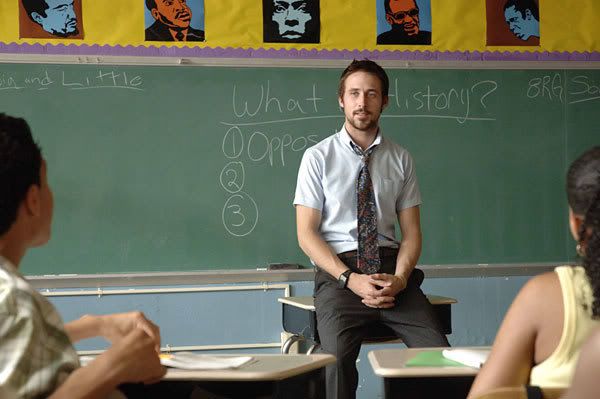
Half Nelson is the bold middle finger to that tradition. Ryan Gosling is not an inspirational teacher and coach. He appears as a roguish and charismatic speaker, but this image is fast eroded by his by his extracurricular activities. - a touch of after class crack cocaine in the girls bathroom, a sprinkling of drink and flirting at a local club. He becomes a friend of sorts with 13 year old Dre, who discovers his drug habit, and both share a downwards journey into the world of drug abuse.

Half Nelson is a beautiful showcase of all things low tech . The screen becomes a gritty and dirty filter into a life which we wish fervently we could all avoid - yet almost perversely, we are drawn towards it. Wordlessly, the impotence and soullessness of smoking crack is conveyed. It is harrowing to see, painted even more vivid by the jilted camera angles, and soft focus on glassy eyes. More real and more deterrent than any anti-narcotics campaign could hope to be.

There are even some hints of hope in his relationship with Dre, who is herself becoming involved in the world of street drugs. They share moments of companionship, riding along in a car, even dancing together at the school dance. As with their whole relationship, even the dance becomes inappropriate, and one of them has to leave. There is no redemption here, only the sandy, crunching taste of a bitter reality.

If you get the chance, get into a Half Nelson. It is a taste of American life so distant from Hollywood glitz, that has become increasingly rare, and precious.

Rating: 4.0/5

Written by Christopher See


Monday, 23 April 2007

Kiwi!


I just believe everyone must watch this. Its absolutely brilliant. Its such a short clip, and its so simple, but the message itself is so powerful. It shows the true meaning of 'less means more'. The music itself is inspired.

There's nothing else I can say, just watch it.

Click here for any questions.

Monday, 16 April 2007

Great Movies: Forest Gump


Some movies are priceless over time, and some movies will always be remembered - regardless of how simple, or upbeat the movie is. Forest Gump falls into those two categories. I've probably watched this movie about 15 times now, and for me, it gets better every time. There has never been a moment where I've not had an urge to look at my DVDs and think 'maybe I'll watch Forest Gump'.

But why is this such a classic to me? Is it the perseverance of this character that strikes me? Maybe. Is it the innocence of Forest? Maybe. Is it the feel good factor of the movie? Maybe. Its probably all of those reasons - there's never a real main theme about this movie, and its generally all about the journey of one man.

The movie opens with a shot of a little feather floating in the air. We all begin to wonder - where will it land? Or will it continue floating? It eventually lands on a man - he strikes you as someone who is oblivious to everything that is going around him, but nevertheless he notices the feather, picks it up from his shoulder, and places it in its scrapbook. A lady comes along, and we then discover that they are both at a bus stop. He then begins to tell her about his life story, and what a life story it is.

The beginning scenes in this movie already summarises Forest as a character, in fact it most probably summarises the whole movie. Sitting there, he gives us a portrayal of his innocence - we slowly grow onto him.


He tells the lady his life story - everything from his birth to his first day of school, how he went to college, joined the army, and participated in nearly every American event in the last half century. Yet throughout it all, he's never too bothered about what's going on - he only cares about those around him; Jenny (played by Robin Wright Penn), Lt. Dan (played by Gary Sinise), Bubba (played by Mykelti Williamson) and his mother (played by Sally Field).

This man has gone through so much that it is unreal. But why are we so fascinated by his story? Why do we care? We care because this man is not very smart, so he can only compensate by following his own heart. Jenny epitomises what we all do - always thinking too much. He is different. He has a certain innocence and ignorance about him that makes us laugh at him at times, but also appreciate him that little bit more.

The acting performances here are superb. Tom Hanks undoubtedly stands out the most here, and he truly deserves the Oscar he won for this. It is already difficult enough by itself to play a dumb man, but it is even harder to play one with heart. I first watched this when I was 7, and at the time, I was fully convinced that Tom Hanks him self was actually a retarded person! That itself for me is a testimony as to how well he has done here.

Robert Zemeckis deserves some credit here for making the transitions between each event flawless. The pace of the movie is done perfectly - it does not seem rushed, and neither does it seem much too slow.

Forest Gump is a story about the journey of one man during time. The feather in the beginning and at the end of the movie is significant as to how we float in and out of events in our lives, and how we never truly grasp it. Like the feather, we wait upon the wind to push us through time. We can never expect what is going to happen next. We can only just live through it and then sit back and look upon it and think on what we have done. Like Forest says, 'Life is like a box of Chocolates, you never know what you're gonna get next.'

Rating: 4.7/5

Written by Kevin Lau

Thursday, 5 April 2007

Good Night, and Good Luck.


Is there really any such thing as unbiased reporting? Do reporters really take all facts into consideration - or do they choose to neglect some and to take facts that will support their case? Are they selective on the images they screen on the television? Good Night, and Good Luck has this underlying theme throughout, and it makes for a compelling argument.

In this movie, directed by George Clooney, it aims to explore the television series done by Edward Murrow (played masterfully by David Strathairn), in which he criticises and reports about the true nature of Senator Joseph McCarthy during the 'Communist Witch Hunt' in the 50s. Murrow, as hard as he tries to only report only the news, he finds himself defending himself as Senator McCarthy begins a series of character attacks on Murrow.

There is so much to discuss about in this movie, there is so much which is political that should be discussed. But in my preference, I'd rather not discuss those issues - they can be left for a more informal conversation, and in many ways it would make this review more about my political ideals rather than about the movie itself.

Back to the question at the start - Is there really any such thing as unbiased reporting? I think this movie answers that clearly in saying there isn't - but nevertheless, its still important for reporters to come out with stories regardless how biased it is. Had Edward Murrow not stuck with his ideals, he would have not exposed Senator McCarthy as the bully he is. The only flaw in Murrow is that he fails to see that he himself is not fair to McCarthy, and to me the most compelling question that was asked to him during the movie was this 'When Senator McCarthy convicted Alger Hiss of Purgatory rather than Treason, why didn't you bring that up? We all censor what we want to hear'.

What George Clooney has done so well here is that he has not taken the easy route and shown McCarthy as this huge monster. Instead he tries to balance it out, show that there are flaws on both sides. Murrow as impressive as he is has his own flaws - he only wants to hear what he deems right. McCarthy's flaws are obvious - he has bullied people until they've become timid, and unwilling to express their own opinions.

The story of the Wershbas (Joe and Shirley, played by Robert Downing Jr. and Patricia Clarkson), represents what McCarthyism has done to people. The company has a policy of not employing married couples, but they are married, and they are afraid of revealing it. The same goes for any communist at the time - they will not reveal themselves, they were much too scared to do so.

The screenplay in this movie is fantastic. I loved how Clooney uses adverts as his transitions. It allows us to remind ourselves that we in the thick of the broadcasting world, in where decisions on what is aired must be considered carefully first. Every other shot is in the CBS building itself, and it allows us to feel as if we're part of their world.

The movie has many great messages - the importance of courageous reporting, the importance of expressing our own opinions. But to me, what stood out the most was that we all censor then and now. It just depends what we choose to do so. There is none among us that actually looks at the world in a 'fair' manner.

Rating: 3.9/5

Written by Kevin Lau